Setting Fence Posts in North Alabama Clay Soil
What you’ll learn
- Bury one-third of the post's length, about 32 to 36 inches for a 6-foot fence.
- Put 4 to 6 inches of crushed stone under every post so water can drain.
- Never pour concrete under the post's end. Trapped water rots it at the ground line.
- Use UC4A or higher ground-contact lumber and check the end tag.
- Call Alabama 811 two full working days before you dig.
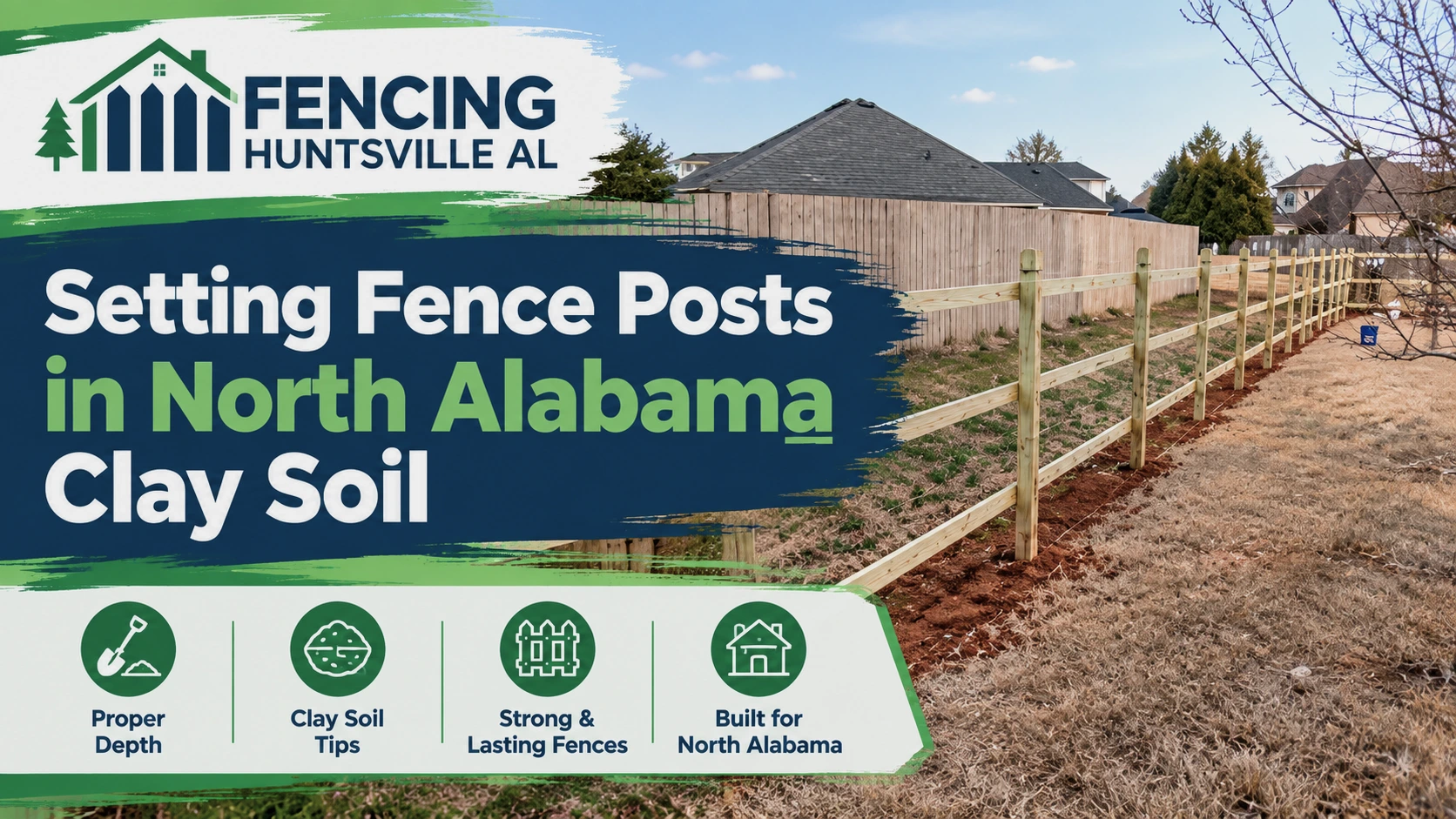
To set fence posts in North Alabama clay soil, dig each hole to one-third of the post's total length (30 to 36 inches for a 6-foot fence), put 4 to 6 inches of gravel in the bottom, and never let concrete seal off the post's end. Red clay holds water, and water trapped against a post rots it from the ground line in.
Why red clay is hard on fence posts in Huntsville and Madison
Red clay doesn't wreck fence posts by crushing them. It wrecks them by holding water where wood can't escape it.
The Tennessee Valley sits on soils weathered from limestone. The Alabama Cooperative Extension System (ACES, 2025) describes them as mainly red clayey soils with silt loam on top, with the Decatur and Dewey series spread across the valley. Dig past the first 8 or 10 inches in most Madison County yards and you hit that dense, sticky, brick-red layer.
Here's the part most fence articles get wrong. Undisturbed Decatur soil is rated well drained in its USDA official series description (USDA NRCS, n.d.). Your backyard in a new Harvest or Madison subdivision isn't undisturbed. Builders scrape the topsoil, push fill around, and run heavy equipment over the lot until the subsoil packs down like a parking pad.
Dig a hole in that and fill it with anything looser, and you've built a small cup. Rainwater runs into the loose fill, hits the packed clay walls, and sits there. We call it the bathtub effect. Your post is the rubber duck.
Short answer: Clay itself won't snap a post. Standing water trapped in the hole will rot a wood post at the ground line and loosen the footing, usually within a few wet seasons.
Want a real read on your own dirt? We check soil and drainage on every free on-site measure. See how we build wood fences for North Alabama yards.
How deep should fence posts be in Alabama clay
Bury one-third of the post's total length, with a floor of 24 inches. For a standard 6-foot privacy fence on 8-foot posts, that's about 32 inches in the ground. Round up to 36 inches on corners, gate posts, and any stretch that faces open wind.
Frost isn't what sets your depth here. Alabama frost is shallow. The Alabama Residential Code (2015 edition, via UpCodes) puts exterior building footings at a minimum of 12 inches below undisturbed ground. A fence post goes much deeper than that for a different reason. Leverage.
A 6-foot privacy fence is a sail. When a spring line of storms rolls across the Tennessee Valley, wind pushes on every square foot of those boards, and the post acts like a lever with the ground line as the pivot. More post below grade means more resistance.
| Fence height | Typical post length | Depth in ground | Hole diameter (4x4 post) |
|---|---|---|---|
| 4 feet | 6 feet | 24 inches | 10 to 12 inches |
| 5 feet | 7 to 8 feet | 28 to 32 inches | 10 to 12 inches |
| 6 feet | 8 feet | 32 to 36 inches | 10 to 12 inches |
| 8 feet | 10 to 12 feet | 40 to 48 inches | 12 inches (6x6 post recommended) |
| Gate posts, any height | Add 1 to 2 feet | 36 to 48 inches | 12 inches |
Add the 4 to 6 inches of gravel base to every depth in that table. A 32-inch post setting needs a 36 to 38 inch hole. For the full breakdown by fence style, see our guide to fence post depth in Alabama and why it matters.
Concrete, gravel, or packed clay, which one holds up best
In North Alabama clay, a concrete collar over a gravel base wins for most privacy fences. The gravel lets water leave the bottom of the hole. The concrete locks the post against wind. What fails is concrete poured straight to the bottom so it wraps the post's end grain in a sealed cup.
Every fence crew in the Tennessee Valley has an opinion on this, and some of them argue about it at church. So here's how the three methods stack up in our soil.
| Method | Holds against wind | Drains water | Easy to replace later | Best fit |
|---|---|---|---|---|
| Concrete to the bottom of the hole | Excellent at first | Poor, traps water at the post end | Hard, you'll jackhammer the old plug | Metal posts only |
| Gravel base plus concrete collar, crowned top | Excellent | Good | Moderate | Most wood privacy fences |
| Crushed stone, tamped in lifts | Good if tamped well | Excellent | Easy | Picket fences, sheltered runs, farm fence |
| Native clay, tamped | Fair when dry, poor when soaked | Poor | Easy | Temporary lines only |
Crushed stone deserves more credit than it gets. Angular stone like #57 locks together when you tamp it in 6-inch lifts, and water passes straight through. The tradeoff is some flex on tall solid fences in high wind. That's why we lean on concrete collars for 6-foot privacy runs and save all-stone settings for open designs.
Bottom line: Pick drainage first and strength second. A post that stays dry at the ground line will outlast a post set in the strongest concrete plug in Madison County.
How to set a fence post in red clay, step by step
Here's the full sequence we use on wood posts in Huntsville-area clay. It works for DIY and it's how our crews do it.
- Call Alabama 811 first. State law requires notice at least two full working days before you dig, not counting the day you call (Alabama 811, 2026). It's free. Hand dig anywhere within 18 inches of a marked line.
- Pick ground-contact lumber. Check the end tag for UC4A or higher. The American Wood Protection Association (AWPA, 2025) says ground contact needs UC4A at minimum, and lumber rated only for above-ground use won't last buried.
- Dig when the clay is damp, not soaked. In August, red clay digs like fired brick. After three days of rain, it's cake batter that glues itself to the auger. A day or two after a soaking rain is the sweet spot. On a dry job, fill each hole with water the night before.
- Size the hole at three times the post width. That's 10 to 12 inches across for a 4x4. Flare the bottom a little wider than the top. The bell shape resists the post pulling upward when wet clay grips and shifts.
- Add 4 to 6 inches of crushed stone and tamp it. This is the drain. Set the post on the stone so the end grain sits in gravel, not concrete.
- Brace and plumb the post. Check two adjacent faces with a level. Screw on two temporary braces.
- Pour concrete to about 4 inches below grade. Keep it above the gravel, never below the post end.
- Crown the top. Slope the concrete away from the post so rain sheds off instead of pooling. Cover the last few inches with soil or stone.
- Wait before hanging rails. Give standard concrete a day or two to cure before you load it with rails and boards. Check the bag for the manufacturer's time.
Uphill clay moves water downhill along your fence line. If your lot slopes, read our notes on drainage on sloped Huntsville fence lines before you pick post spots.
What a leaning fence post in Madison County is telling you
A post that leans after heavy rain usually has one of two problems. Either the footing was too shallow for the wind load, or water softened the clay around a footing that never drained. Rot at the ground line is the third suspect, and it's easy to test.
Push a screwdriver into the post an inch below the dirt. If it sinks in with little resistance, the wood is rotting. No amount of re-tamping will save that post.
- Post solid, footing loose. The concrete plug is rocking in soft clay. Usually a reset job, not a replacement.
- Post soft at grade. Rot. Replace the post and fix the drainage that caused it, or the new one follows it.
- Several posts leaning the same direction. Wind load beat the depth. The whole run was likely set shallow.
We go deeper on failure patterns in why fences lean in North Alabama and how to fix it. If it's already down, our fence repair crew can tell you whether you need three posts or thirty.
What we found on a Harvest fence that failed at year six
Last spring we got a call from a homeowner on a half-acre lot in Harvest. Her 6-foot board-on-board privacy fence, 212 linear feet, had eleven posts leaning after an April storm. It was six years old. Treated pine should go a lot longer than that.
We pulled the first post and found the whole story. The original installer had poured concrete to the bottom of each hole. Every plug held about a cup of standing water around the post's end. The wood looked fine above ground. Below grade, the bottom 8 inches had gone soft enough to crumble in hand.
| Detail | Original install | Our rebuild |
|---|---|---|
| Post depth | 22 inches | 34 inches |
| Hole bottom | Concrete, no drainage | 5 inches of tamped #57 stone |
| Post rating | Tag missing | UC4A, tag checked |
| Concrete top | Flat, level with grass | Crowned, 4 inches below grade |
| Posts replaced | 29 of 31, only two corner posts were sound | |
The fix wasn't exotic. Deeper holes, a stone drain, the right lumber. The difference between a fence that lasts six years and one that lasts twenty was about four inches of gravel per hole.
Are metal fence posts better in clay soil
Galvanized steel posts don't rot, so the bathtub effect matters much less. That makes concrete to the bottom acceptable for chain link and ornamental steel. Steel can still rust at the ground line if the coating gets scraped, and it won't hide behind a wood privacy fence the way people hope.
Many of our wood privacy fences in Madison now go on galvanized steel posts with brackets, with wood facing boards. You get the look of wood and a post that shrugs off wet clay. Our fence materials guide for North Alabama compares the full range, and the best fence for North Alabama weather covers how each one handles our heat, storms, and humidity.
Auger stuck on rock? Upland yards near Monte Sano and parts of Hazel Green carry fist-size flint-like rock in the clay. Budget extra time, bring a digging bar, and don't let a rock push you into a shallow hole. Moving the post six inches down the line beats cutting the depth.
Should you set fence posts yourself or hire it out
Set them yourself if the run is short, the lot is flat, and you own a digging bar and a free weekend. Hire it out when the line runs over 150 feet, crosses a slope, hits chert, or includes a gate. Gate posts in clay carry the heaviest load on the whole fence.
If a permit or HOA approval is in the way, handle that before the first hole. Our North Alabama fence permit guide walks through the city and county rules, and we'll handle permits and HOA paperwork on jobs we build. For what the whole project runs, the Huntsville fence cost guide has current numbers.
Clay soil doesn't have to mean a leaning fence. It means the post hole needs a drain. Call (256) 877-5278 or request a free on-site estimate below, and we'll look at your soil, your slope, and your fence line before anybody picks up an auger.
Frequently asked questions
Need a fence quote? Talk with our local team.