Best Fence for North Alabama Weather
What you’ll learn
- North Alabama fences face four stressors at once: humidity, real freezes, moving red clay, and Dixie Alley storms
- Huntsville gets just over 54 inches of rain a year, with 43% falling December through March (NWS Huntsville)
- Frost heave isn't the real threat here, Alabama's frost line stays under a foot deep, red clay movement is
- Alabama sits in the USDA's highest termite pressure zone, year-round, not seasonal
- Aluminum and vinyl need the least maintenance against this specific combination of stressors, wood and chain link still work with the right setup
- Late fall through early winter is the strongest window to install, before spring storms and termite swarm season
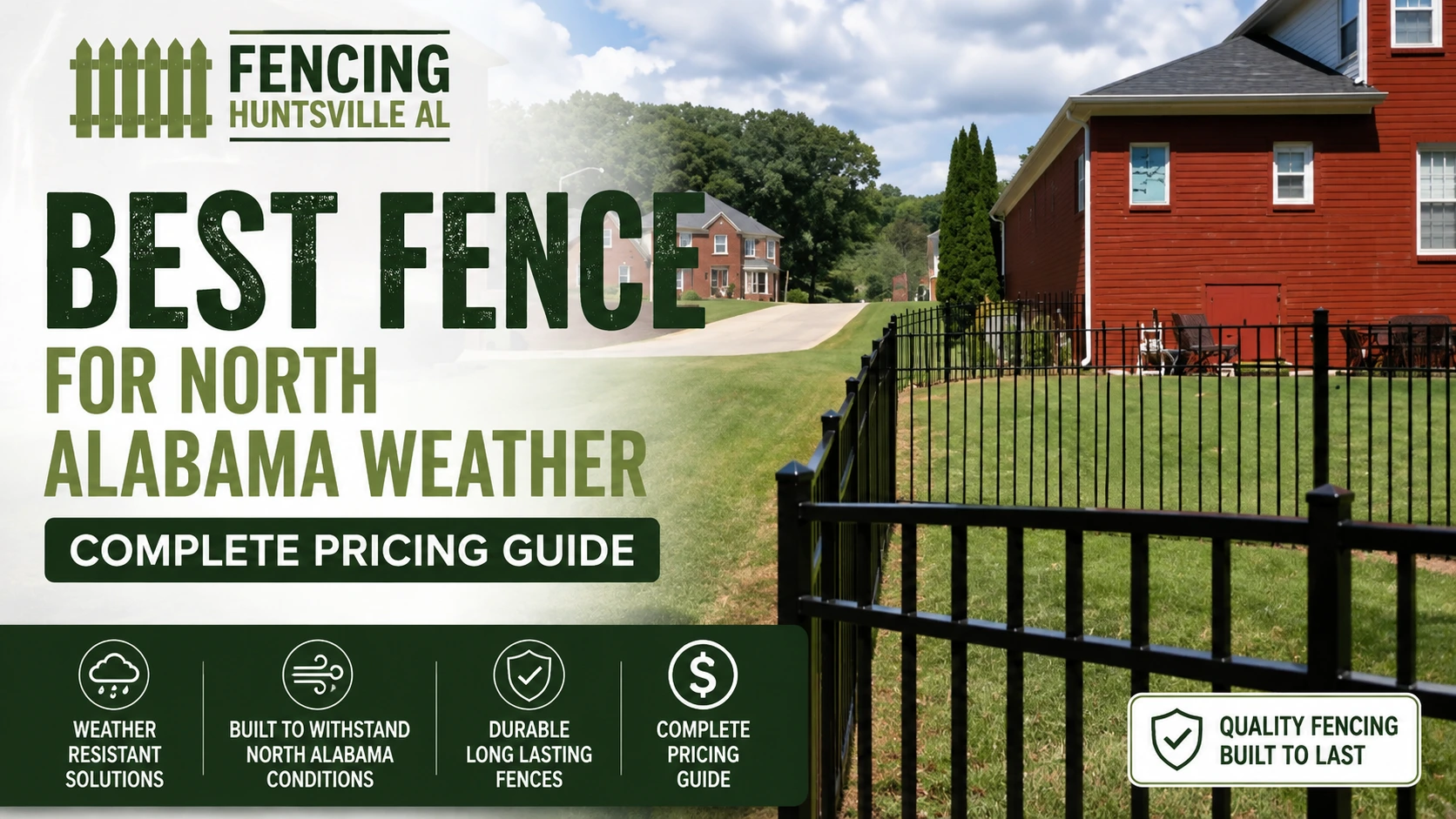
For most yards in Huntsville, Madison, and the rest of the Tennessee Valley, an aluminum or vinyl privacy fence handles the local weather combination of heavy rain, real winter freezes, red clay movement, and spring storms better than wood over a 15- to 20-year span. Wood still works. It just asks more of you.
What North Alabama Weather Actually Does to a Fence
North Alabama stacks four fence stressors on top of each other that most regions only deal with one or two of at a time. Rain and humidity sit on wood and untreated metal for months. Winter freezes come and go instead of settling in for a season. Red clay swells after a storm and pulls back tight during a dry August. Spring and fall bring wind strong enough to take a privacy panel down in one afternoon.
Ask five North Alabama homeowners what wrecked their old fence and you will get five different weather-related answers. All five are usually right.
- Year round rain and humidity that keep wood and ferrous hardware wet longer than they can dry out between storms
- Winter freezes that arrive and break within days instead of holding a hard freeze all season
- Expansive red clay that moves enough to loosen a shallow or under-mixed post footing over several years
- Straight line wind and tornado activity concentrated in spring, with a second smaller peak in late fall
Want a fence built for what your specific lot actually faces? We measure on site and walk you through the material tradeoffs for your yard, free, before you commit to anything.
Which Fence Material Handles Tennessee Valley Humidity Best
Huntsville's normal annual precipitation runs just over 54 inches, and December through March alone accounts for about 43 percent of that total, according to National Weather Service Huntsville climate records. That is not a light drizzle problem. It is months of sustained moisture load on whatever material is standing in your yard.
Rain itself does not kill a fence. How long a material stays wet after the rain stops is what actually matters.
Wood absorbs moisture and needs airflow and drainage to dry back out between storms. A fence set too close to the ground, buried in mulch, or shaded by a fence line of trees stays damp far longer than one installed with proper ground clearance, which is where rot usually starts first.
Vinyl does not absorb water at all, so humidity is close to a non-issue for the material itself. The main upkeep is an occasional wash to keep mildew film from building up on the shaded side of the fence, which is a cosmetic problem, not a structural one.
Aluminum and ornamental steel handle humidity well when the coating is intact. Powder-coated aluminum resists corrosion almost entirely. Steel needs a coating that has not been chipped or scratched down to bare metal, since that is where rust actually starts.
Chain link in galvanized or vinyl coated finish tolerates humidity fine. The fabric itself rarely fails from moisture. Ungalvanized hardware, ties, and tension bands are the weak point.
For a full side-by-side on cost and material tradeoffs, our fence materials guide for North Alabama breaks down each option in more depth than one section here can cover.
Does Alabama's Freeze and Thaw Cycle Really Threaten Your Posts
In most of the country, frost heave is the reason a fence post works itself loose over time. Alabama's frost line rarely drops past about a foot below grade, which is shallow enough that frost heave is not the main threat here the way it is in Ohio or Minnesota. The Alabama Residential Code sets a 12-inch minimum footing depth statewide, and that minimum has more to do with frost protection for buildings than with fence posts specifically.
What actually loosens a fence post here is the clay itself. Tennessee Valley soil swells when it takes on water and shrinks back as it dries, and it repeats that cycle every single year. A post set too shallow, or set in a footing without enough concrete around it, works its way looser with each swing instead of failing all at once.
There is a useful distinction most homeowners never hear. USDA soil surveys classify the Tennessee Valley as Alfisols, which move less dramatically than the true expansive Vertisol clays found in Alabama's Black Belt region further south. Our red clay is real, and it does move. It is not the extreme shrink-swell soil that causes foundation problems in Central Alabama.
How Deep Fence Posts Need to Go in Alabama Clay
The rule that actually governs post depth here is structural, not frost-related. Set posts at roughly one third of the fence's above-ground height, with a 24-inch minimum for a standard 6-foot privacy fence, and use a full concrete footing rather than dirt tamped back into the hole. That depth resists the clay's seasonal movement and gives the post enough leverage to stand up to wind, which is the bigger threat in this region anyway. Our fence permit guide for North Alabama covers the exact code requirements by fence height and jurisdiction.
Which Fence Holds Up Best in Dixie Alley Storms
Alabama averages 42 tornadoes a year based on data collected since 1985, and Huntsville sits inside what meteorologists named Dixie Alley back in 1971, a region known for violent, long track storms concentrated in spring with a smaller second peak in late fall, according to the Encyclopedia of Alabama. Most of that activity never reaches tornado strength. It still means straight-line wind gusts strong enough to take a fence down are a normal part of a North Alabama spring.
A fence fails in wind the same way a sail fails, by catching more air than the structure underneath can hold. A solid privacy panel presents a full wall of surface area to a gust. A picket fence, an aluminum fence with open spacing between rails, or a chain link fence lets wind pass through instead of pushing against it. That open spacing is a structural advantage in a storm, and it happens to shape the whole look of the fence too.
Do Aluminum Fences Survive Straight Line Wind Better Than Wood
Generally, yes, for two separate reasons. The open picket spacing sheds wind load instead of catching it, and aluminum panels typically bolt into posts rather than relying on nailed or screwed wood rails that can work loose after repeated gusts. That does not make wood a bad choice. It means a wood privacy fence on an exposed, wide open lot deserves deeper posts, closer post spacing, and rail hardware rated for the load, not the minimum spec a national lumber yard fence kit ships with.
- Set posts to the full structural depth for the fence height, not the shortcut depth a crew in a hurry might use
- Use pre-mix or properly cured concrete footings rather than loose gravel backfill on any fence over 5 feet
- Space posts tighter on wide open lots with no windbreak from trees or structures
- Inspect wood rail connections after any severe storm warning, since a loosened rail is how a full panel comes down in the next one
How Much Termite Pressure Should You Plan For
Alabama sits in the USDA's highest termite pressure category, Termite Infestation Probability Zone 1, meaning termite activity here runs at significant levels essentially year-round rather than in a short seasonal window. The Alabama Cooperative Extension System tracks subterranean termite pressure across the state and recommends ongoing prevention rather than a one-time treatment, which tells you how seriously the risk is treated by people who study it for a living.
Does Pressure Treated Wood Actually Stop Termites
Pressure-treated pine reduces termite risk significantly compared to untreated lumber, but it does not eliminate it. The preservative protects the wood fibers the chemical actually reaches. Cut ends, drilled holes, and any surface where the treatment layer has been compromised are still vulnerable, which is why a cut post bottom should always get a field-applied end-cut preservative before it goes in the ground.
Cedar carries natural oils that resist both rot and insects better than pine, which is part of why it costs more. Vinyl, aluminum, and ornamental steel are not a food source for termites at all, and most composite fencing carries far lower risk than solid wood, though it is worth confirming the specific product's composition since formulations vary by manufacturer.
Which Material Actually Lasts Longest Here
Every material trades off differently against North Alabama's four stressors. The table below ranks each option qualitatively across humidity, termite pressure, wind, and sun exposure. For exact installed cost by material, our complete fence cost guide for Huntsville is the source we keep updated with current pricing.
| Material | Humidity and Rot Risk | Termite Risk | Wind Tolerance | Sun Fade |
|---|---|---|---|---|
| Pressure treated pine | Moderate, needs staining and ground clearance | Reduced, not eliminated | Moderate, depends on panel style | Grays without maintenance |
| Cedar | Low to moderate, natural oils help | Low, natural resistance | Moderate, depends on panel style | Grays without staining |
| Vinyl | Very low, does not absorb water | None | Good with proper post spacing | Can yellow or chalk over decades without UV stabilizer |
| Aluminum or ornamental steel | Very low with intact coating | None | Very good, open picket design | Minimal with quality powder coat |
| Galvanized chain link | Low, fabric holds up well | None | Very good, wind passes through | Minimal |
| Composite | Low, engineered to resist rot | Low, varies by product | Moderate to good | Minimal with quality cap stock |
See our materials guide for exact lifespan ranges and cost comparisons by product tier, since those figures shift as manufacturers update their warranty terms.
When Is the Best Time to Install a Fence in North Alabama
Late fall through early winter is the strongest window for a North Alabama fence install, roughly October through January. The ground is workable, rainfall has not yet hit the heavier December through March stretch, and you sidestep the spring storm season entirely before your posts have had a full season to cure in the clay.
Spring is the worst time to break ground, not because the weather stops a crew from working, but because a freshly set post has not had time to lock into the surrounding clay before the wettest, windiest stretch of the year arrives. A post given a full winter to settle handles its first real storm season far better than one installed the week before it.
Termite swarm season adds a second reason to avoid a spring install for wood fencing specifically. Subterranean termites in Alabama swarm on warm days after rainfall, most commonly in spring, so a wood fence with fresh cut ends and exposed grain sitting in the ground during peak swarm activity is not the ideal timing if you have a choice in the matter.
What We've Learned From Fences We've Built Through North Alabama Storms
If your yard sits wide open with no windbreak, or you are already fighting a leaning wood fence after last spring's storms, we can walk your property and tell you honestly whether a repair, a rebuild, or a different material altogether is the right call. Our Madison and Harvest crews see this exact pattern every storm season, and it is rarely the same fix twice.
Whatever material ends up right for your lot, our residential fencing team sets every post to the depth your fence height and site conditions actually require, not the fastest depth to dig.
Frequently asked questions
Need a fence quote? Talk with our local team.